

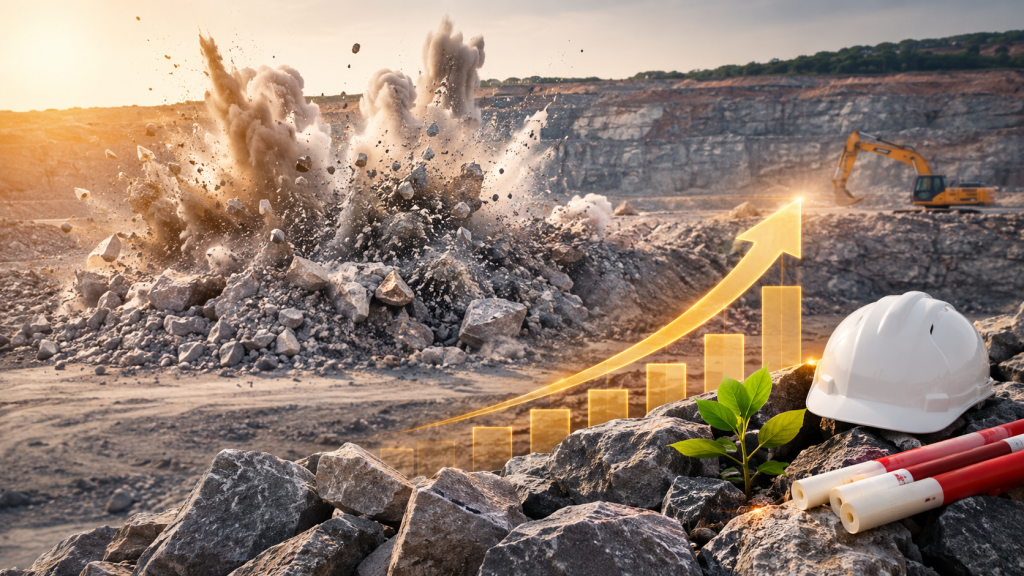
If you ask a mine manager where their biggest cost-saving opportunities are, blasting rarely tops the list. Fuel, labour, equipment maintenance, explosive prices — these get the attention. Blasting is often treated as a fixed cost: drill the pattern, load the holes, fire the round, move on.
Fragmentation Is a Decision, Not an Accident
When a blast produces coarse, oversized rock, that cost doesn’t disappear — it moves downstream and grows. Oversized boulders need secondary breaking, which means extra drilling, extra explosive, or extra time with a hydraulic hammer. Loading equipment works harder and slower against a poorly broken pile. Haul trucks carry less effective payload per cycle when material is irregular. And at the crusher, oversized feed reduces throughput, increases wear on liners and jaws, and — for operations like cement plants — raises the grinding energy needed downstream to get the material to the fineness the process requires.
None of these costs show up on a “blasting” line item. They show up scattered across maintenance budgets, energy bills, and productivity reports, which is exactly why fragmentation quality is so easy to underinvest in: the cost of getting it wrong is real, but it’s invisible at the point where the decision gets made.
A Concrete Example
A recent field trial at Zuari Cement’s Sitapuram Limestone Mine puts numbers to this. By introducing PVC stemming plugs to create a controlled air deck above the explosive charge, the trial team achieved measurably better fragmentation and greater muckpile displacement — while simultaneously reducing the ANFO load per hole from 83 kg to 77.5 kg.
The direct saving worked out to roughly ₹259 per hole, or ₹0.59 per tonne of limestone, after accounting for the cost of the plugs themselves. On a mine producing at scale, savings like that compound quickly across thousands of holes a year. And that figure captures only the explosive cost difference — it doesn’t yet quantify the secondary savings in reduced oversize handling, faster loading cycles, or lower crusher wear that better fragmentation typically delivers.
Why This Is an ROI Conversation, Not Just a Technical One
The appeal of an intervention like stemming plugs is that it doesn’t ask for capital expenditure, new equipment, or a change of explosive supplier. It’s a modification to existing charging practice that a blast crew can adopt within a normal shift. That makes the ROI calculation unusually clean: a small, well-defined cost per hole, weighed against explosive savings that are directly measurable and downstream productivity gains that, while harder to isolate precisely, are consistently reported across the wider body of blasting research.
For operations managers under pressure to find efficiency wherever it exists — and for finance teams increasingly asked to justify every cost line — blasting deserves a second look. It’s one of the few places in the mining value chain where a low-cost, low-disruption change can pay for itself immediately and keep paying dividends through every stage that follows.
The Real Question
The question worth asking isn’t “can we afford to trial a change to our stemming practice?” It’s “what is poor fragmentation already costing us, and how much of that is hiding in budgets we don’t associate with blasting at all?”
Sitapuram’s early results suggest that for at least some mines, the answer is: more than expected, and more recoverable than assumed.
Uttam Blastech Pvt Ltd runs data-driven blast optimisation trials that connect blasting decisions to bottom-line outcomes. If you want a clear-eyed look at what your current fragmentation practice is costing you, we’d be glad to help you find out.