

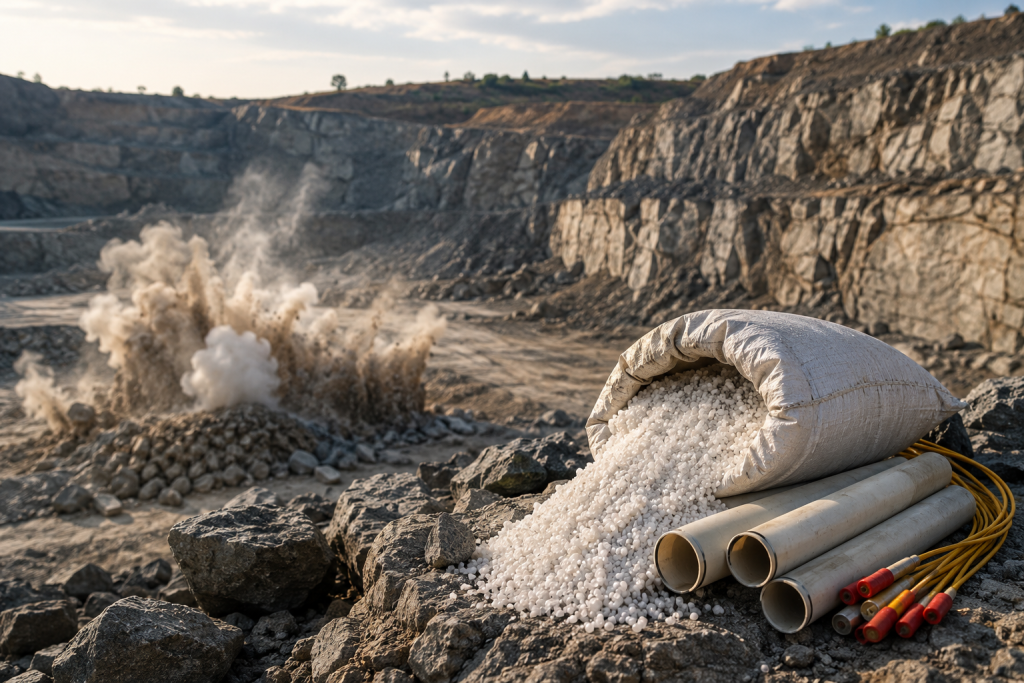
For decades, Indian mining operations could treat ANFO as a reliable, low-cost commodity — available in bulk, priced predictably, and rarely a strategic concern. That assumption is being tested. Ammonium nitrate is an energy-intensive product to manufacture, and global supply disruptions tied to energy market volatility in key producing regions have periodically squeezed both the availability and the price of explosives feeding Indian quarries and mines.
For an industry built around blasting as its primary means of rock fragmentation, that shift changes the calculus. When explosive supply is abundant and cheap, the incentive to extract maximum value from every kilogram is weak. When it isn’t, efficiency stops being a nice-to- have and becomes operationally necessary.
The Usual Levers and Their Limits
Mining operations generally have four levers available to improve explosive efficiency:
– Higher-energy explosives and better initiation accessories — effective, but often constrained by what’s approved, available, and contracted with suppliers.
– Optimised blast design — burden, spacing, sub-drill, and stemming length — already implemented to varying degrees at most established Indian quarries, leaving diminishing room for further gains.
– Borehole liners, to improve coupling between explosive and rock.
– Stemming plugs and air-deck techniques, which modify how energy is contained and released within the hole itself.
Of these, the first two are frequently already optimised or constrained by factors outside a mine’s direct control — explosive selection is often dictated by regulatory approval and supply agreements, and design parameters have typically already been through several rounds of refinement. That leaves stemming technique as one of the few remaining levers that’s genuinely under-exploited at most sites, and one that can be adopted incrementally without disrupting existing drilling or charging infrastructure.
A Practical Illustration
A recent trial at Zuari Cement’s Sitapuram Limestone Mine in Telangana offers a useful data point. By introducing PVC stemming plugs to create a controlled air deck above the explosive column, the mine reduced ANFO consumption per hole from 83 kg to 77.5 kg — a real cut in explosive tonnage per hole — while simultaneously achieving better fragmentation and greater muckpile throw than the conventionally stemmed section of the
same blast.
That’s not a trade-off between efficiency and performance. It’s evidence that a meaningful share of explosive energy in conventional stemming was being wasted rather than converted into useful rock breakage — energy that a properly engineered air deck can help recover.
Published research backs this up at a broader scale: air-deck techniques have been reported to deliver explosive savings in the range of 15–30% across various site conditions, alongside reduced fly-rock, airblast, and ground vibration. The exact figure always depends on rock properties, hole diameter, and how the air deck is sized — which is exactly why site-specific validation trials, like the one at Sitapuram, matter more than generic industry benchmarks.
The Strategic Case
In a tightening explosive supply environment, the mines best positioned to weather volatility are the ones that use technique, not just tonnage, to extract fragmentation performance. Stemming plugs won’t insulate an operation from every price shock, but they represent a low- capital, quickly deployable way to reduce dependence on raw explosive volume per tonne of ore or rock produced — precisely the kind of resilience that becomes valuable when supply chains wobble.
For quarry and mine operators reviewing their explosive strategy this year, the question is less “should we use less ANFO” and more “how much of our current usage is actually doing useful work, versus venting away as wasted energy.” Increasingly, that’s a question worth answering with a controlled field trial rather than an assumption.
Uttam Blastech Pvt Ltd works with mining operations across India to design blast trials that reduce explosive dependency without compromising fragmentation performance. Reach out to discuss a stemming audit for your site.