

There’s a moment on every quarry face, right after the dust settles, when you can tell whether a blast worked. Big, angular boulders scattered across the muckpile mean trouble ahead — more secondary breaking, slower loading, a crusher that’s going to complain all shift. A tight, well-broken pile means the opposite: a smooth day.
At Zuari Cement Limited’s Sitapuram Limestone Mine in Telangana, a recent trial set out to test a simple question: could a low-cost plastic device, inserted above the explosive charge, reliably tip a blast toward that second outcome — and save money while doing it?
The Setup
The trial team, led by Uttam Blastech Pvt Ltd, split a 29-hole staggered blast face into two matched halves. Both sides were drilled to the same 150 mm diameter, 8.5 m depth, 4 m burden, and 5.5 m spacing, and both were loaded with the same explosive, ANFO. The only variable that changed was the stemming.
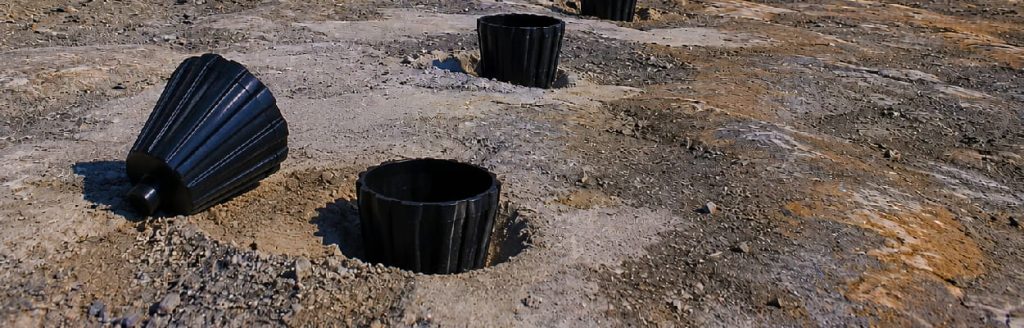
One half was stemmed the conventional way, with drill cuttings packed above the explosive column. The other half got a PVC stemming plug inserted directly above the charge before the cuttings went in — creating a controlled air gap, or “air deck,” of about 0.8 metres between the explosive and the stemming material above it.
Everything else — delay timing, face geometry but for explosives charge — was held constant, so any difference in outcome could be attributed to the plug itself.
What Happened
The results were visible before anyone ran a single calculation. The plug-assisted side of the face broke up more evenly, with noticeably less oversized, blocky material sitting in the muckpile. Rock that would normally need secondary breaking before it could go to the crusher was already sized right.
The plug side also threw the broken rock further forward — a strong sign that more of the detonation’s energy was doing useful work on the rock instead of venting away or dissipating as ground vibration and airblast.
And the Numbers
Here’s where it got interesting for the finance team. Because the air deck let the crew load less explosive per hole — 77.5 kg of ANFO instead of 83 kg — while still achieving better fragmentation, the plug side cost less overall, even after paying for the plug itself:
| With Stemming Plug | Without Stemming Plug | |
|---|---|---|
| ANFO per hole | 77.5 kg | 83 kg |
| Cost of ANFO | ₹6,231 | ₹6,673 |
| Plug cost | ₹183 | Nil |
| Total cost per hole | ₹6,504 | ₹6,763 |
That works out to a saving of roughly ₹259 per hole, or about ₹0.59 per tonne of limestone produced — on top of the fragmentation and throw improvements, which carry their own downstream savings in loading, hauling, and crushing that weren’t even fully captured in this cost model.
Why It Matters
None of this required new drilling equipment, a change in explosive supplier, or retraining the blast crew. The plug slots into the existing charging sequence. That’s precisely what makes it worth paying attention to: it’s a rare case in blasting optimisation where you can improve output quality and reduce cost at the same time, without disrupting operations to get there.
The trial team has recommended Sitapuram move toward routine adoption, pending confirmation across a larger number of blasts, and is already planning follow-up trials with a reduced ANFO column and extended air deck to see how much further the savings can go.
For a limestone mine feeding a cement plant, where fragmentation quality ripples all the way through to grinding energy at the mill, that’s a result worth watching closely.
Uttam Blastech Pvt Ltd designs and validates blast optimisation trials for mining operations across the Globe. If your site is looking to benchmark stemming performance or reduce explosive cost per tonne, get in touch.