

Ask most blast crews what stemming does, and you’ll get a simple answer: it keeps the gas in the hole so the explosive does its job instead of venting uselessly out the top. That’s true, but it’s only half the story. The other half is about physics that most people never think to look for — and it’s the reason a small plastic device can measurably change how rock breaks.
Compression Is Not the Whole Story
Rock is deceptively tough in compression. Competent limestone can resist over 80 MPa of compressive stress before it fails. But put that same rock under tension, and it gives up far more easily — often somewhere between 8 and 12 MPa. Rock, in other words, is roughly ten times weaker when you pull on it than when you push on it.
Conventional blasting relies heavily on compressive shock and gas pressure to do the breaking. It works, but it’s not using the rock’s weak point efficiently. Air-deck stemming — the technique behind stemming plugs — is built around exploiting that weak point directly.
What Actually Happens Inside the Hole
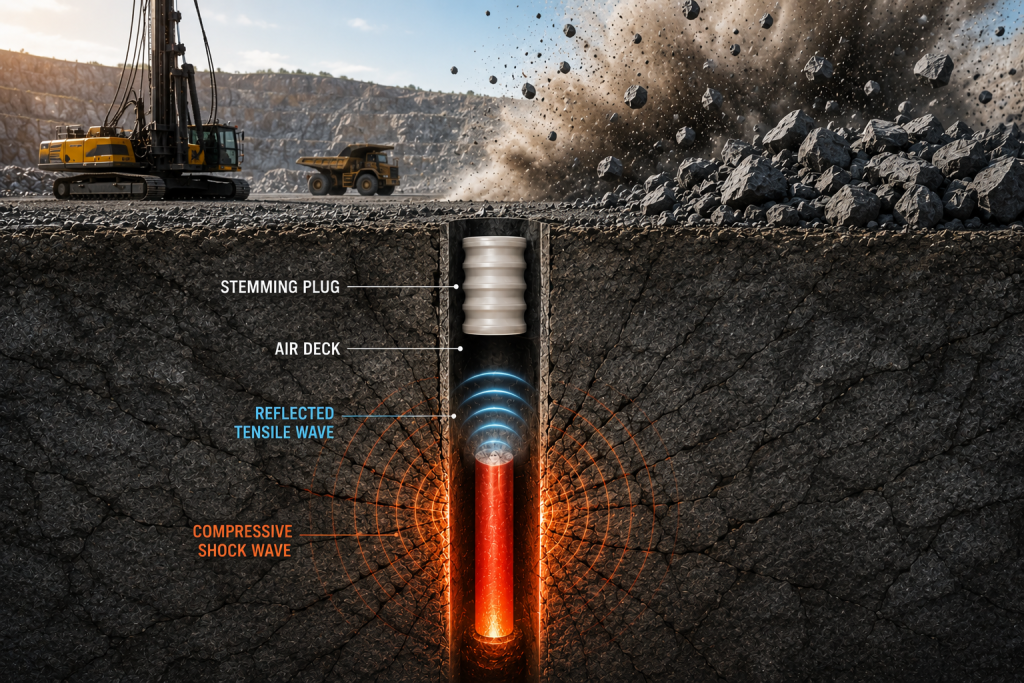
When a stemming plug is placed above the explosive column, it leaves a gap of air between the top of the charge and the stemming material above. That gap is the air deck.
At the moment of detonation, a high-pressure shock wave races up through the explosive column. When it hits the air deck, it meets a sudden, dramatic change in acoustic impedance — going from dense, tightly coupled explosive and rock into a pocket of compressible air. Physics dictates that at a boundary like this, part of the wave reflects back the way it came, but as a tensile wave rather than a compressive one.
That reflected tensile wave travels back down through the already-shocked rock and explosive column, and because rock is so much weaker in tension, it drives fracturing far more efficiently than the original compressive pulse alone. The net effect: more fracture surfaces, more uniform breakage, and less energy wasted crushing rock immediately around the borehole wall — a zone that gets pulverised in conventional blasting without contributing much to overall fragmentation.
The Second Job: Sealing the Hole
There’s a mechanical piece to this too. As detonation gases expand into the air deck, they build pressure against the underside of the plug. A well-designed plug folds outward under that pressure and wedges firmly against the borehole wall, forming a seal.
That seal matters because it stops detonation gas from venting prematurely through the collar of the hole — a common failure mode with drill-cuttings-only stemming, where loosely packed material can blow out before it’s finished doing useful work. By holding the seal longer, the plug extends the duration the pressure pulse acts on the surrounding rock, squeezing more fragmentation and displacement out of the same charge.
Why This Isn’t Just Theory
This isn’t a new or speculative idea — it’s been studied across dozens of published trials over the past three decades, from Armstrong’s foundational 1994 work on stemming quality through more recent field studies by Saharan et al. and Choudhary and Rai. Reported explosive savings from air-deck techniques generally fall in the 15–30% range, alongside documented reductions in fly-rock, airblast, and ground vibration — though the exact numbers always depend on rock mass properties, hole diameter, explosive type, and how the air deck is sized, which is why site-specific trials remain essential.
That’s the underlying mechanism behind results like those recently observed at Zuari Cement’s Sitapuram Limestone Mine, where a stemming plug trial produced visibly finer fragmentation and greater muckpile throw compared to conventional stemming — a real-world confirmation of what the physics predicts.
The Takeaway
Stemming isn’t just a passive plug at the top of a hole — it’s an active part of the blast design, with its own physics to exploit. Understanding the air-deck mechanism is the first step toward using it deliberately, rather than treating stemming as an afterthought once the “real” blast design is finished.
Uttam Blastech Pvt Ltd helps mining operations apply blast physics like this to real sites — turning published research into measurable, site-validated results. Talk to us about auditing your current stemming practice.